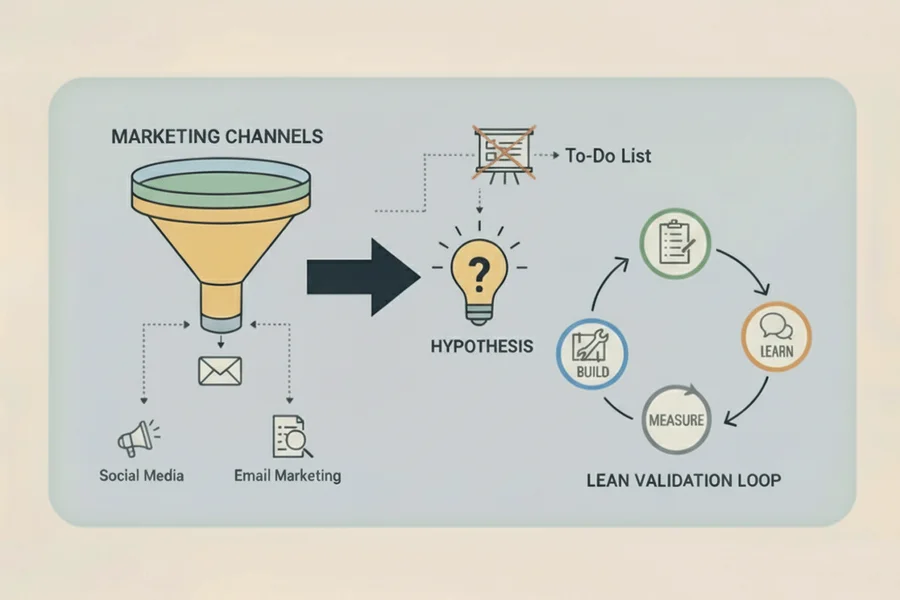
For decades, the startup marketing playbook was simple: Build a website, optimize for Google, and wait for the clicks. This linear path to customer discovery has been irrevocably shattered. The modern buyer’s journey is no longer a straight line from search engine to website; it’s a chaotic, fragmented journey across multiple platforms, often starting and ending without ever touching your own domain.
Today’s buyers split their search, validation, and shopping across four distinct environments:
- Classic Search: Google and Bing (for research and long-form content).
- AI Answers: Generative AI tools like ChatGPT, Gemini, and Perplexity (for direct, summarized answers).
- Social Search: Platforms like TikTok, Instagram, and YouTube (for discovery, demonstration, and authenticity).
- Marketplaces: Amazon, Etsy, and specialized B2B directories (for price, availability, and instant fulfillment).
This fragmentation has rendered the old SEO model obsolete for Minimum Viable Products (MVPs). When 73% of buyers now integrate AI into their purchasing decisions, and Gen Z is using TikTok as their primary search engine, relying solely on domain authority and link-building is a recipe for wasting scarce resources.
The New Reality: Your buyer is looking for a summarized answer in an LLM, seeking social proof and demonstration on TikTok, and demanding instant fulfillment validation on Amazon, all before they consider clicking your Google ad.
The Lean Imperative: Fragmentation as a Mandatory Filter
For a startup operating under the Lean Startup methodology, fragmentation is not a problem to be solved universally—it is a mandatory filter to force focus. Lean startups run on scarcity: scarcity of time, scarcity of capital, and scarcity of attention. You absolutely cannot afford to optimize your content, code, and campaigns for all four paradigms simultaneously.
The BUILD phase of the Lean Channel Validation Playbook is the process of designing an efficient experiment that conserves all three of these scarce resources. Your marketing spend must be viewed as an R&D budget aimed solely at generating validated learning, not just impressions.
The Guiding Principle: The "87% Rule" of Channel Focus
Early efforts must be laser-focused on the single channel where the majority of your early adopters reside. Data suggests that success is highly concentrated:
- Traffic Dominance: An estimated 87% of high-value, AI-driven traffic currently originates from dominant LLM platforms (e.g., Google/Gemini and OpenAI/ChatGPT).
- Market Concentration: Similarly, a vast majority of product sales for consumer goods are concentrated on the largest marketplaces.
The lesson: Avoid the "87% Trap"—the habit of deploying effort everywhere. Use the data to focus all initial BUILD efforts on the channel with the highest probable return. If your user is a B2B researcher, the first MVE must target AI Answers. If your user is Gen Z, the first MVE must target Social Search.
The Anatomy of the Minimum Viable Experiment (MVE)
The Minimum Viable Experiment (MVE) is the core unit of work in the BUILD phase. It replaces the traditional, multi-month campaign plan with a rigorous, time-boxed test designed to answer one crucial question: Does this channel work for me right now?
The Hypothesis Blueprint: Making Falsifiable Bets
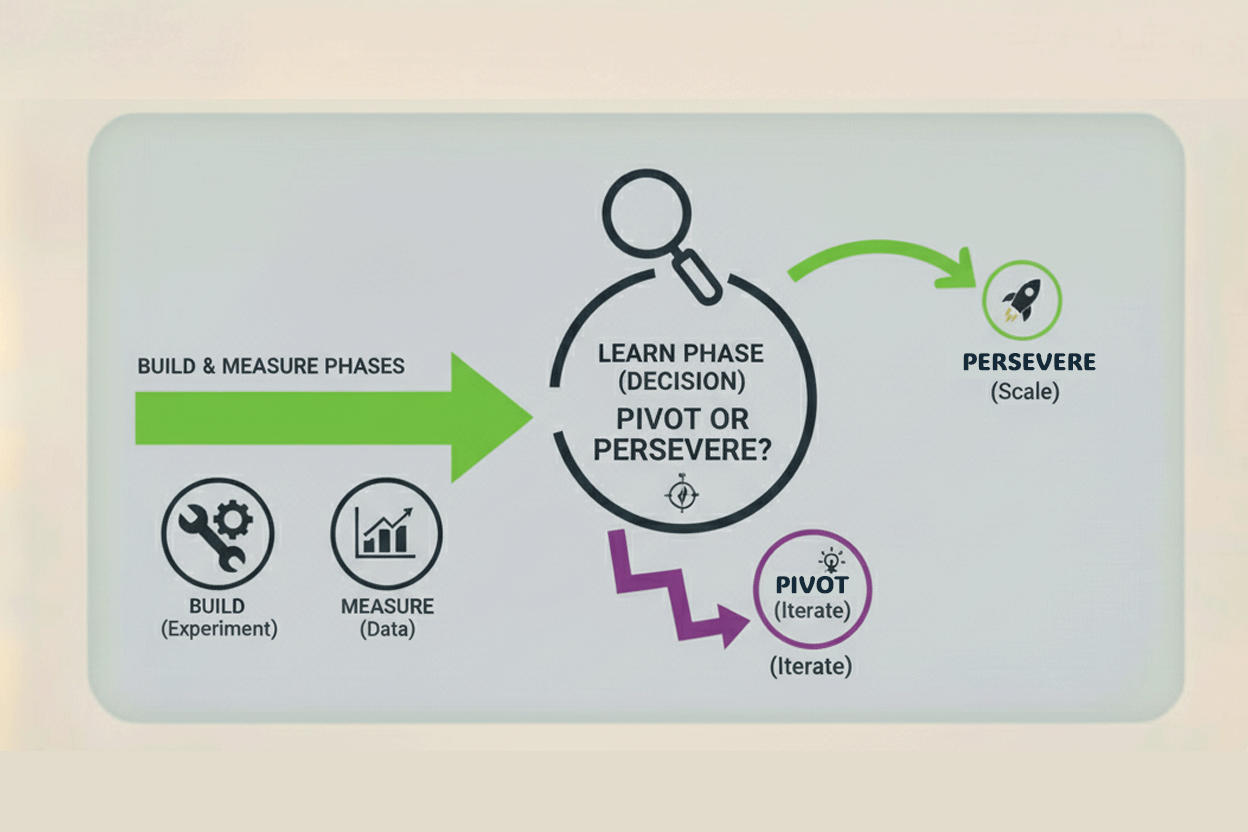
The most common failure in startup marketing is making vague pronouncements instead of falsifiable hypotheses. A good hypothesis forces a decision—Pivot or Persevere.
| Bad Hypothesis | Good (Falsifiable) Hypothesis | Learning Potential |
|---|---|---|
| "We should post some videos on TikTok to drive traffic." | We believe TikTok (Social Search) will generate 15 High-Intent DMs from designers struggling with X problem because they seek visual solutions. | Validates user behavior and qualitative feedback as the primary output. |
| "We need to update our blog for Google SEO." | We believe Google (Classic Search) will generate 5 Qualified Demo Requests for SaaS buyers using Long-Tail Keyword Y because they are in the final purchase intent stage. | Validates a specific keyword/intent for B2B pipeline generation. |
| "Amazon might be a good way to sell our product." | We believe Amazon (Marketplace) will achieve a 5% Listing Conversion Rate with first-time buyers in the US because the high review count overcomes our new brand's obscurity. | Validates conversion efficiency and pricing strategy against the competition. |
Structure Refined: We believe [Channel] will generate [Specific, Measurable Outcome] for [Precise Audience Micro-Segment] because [Core Assumption About Their Behavior/Pain Point].
Timebox and the "Failure Budget"
The Lean Mandate is about speed. An MVE must be rigorously time-boxed—a 14-day sprint is the ideal Maximum Viable Timebox.
Furthermore, every MVE must be assigned a Failure Budget. This is a strict, capped amount of capital, time, or operational effort (e.g., $500, 14 days, 5 founder hours). If the budget is exhausted before the [Specific, Measurable Outcome] is achieved, the experiment is immediately classified as a failure, and you must Pivot/Kill the channel without emotional attachment. The Failure Budget prevents sunk cost fallacy and preserves precious runway.
Audience Precision: The Micro-Segment Test
You cannot test "all B2B users" on "all of LinkedIn." The BUILD phase requires you to identify the smallest viable audience segment that represents your first viable customer.
Tactical Segmentation:
- Define the Pain Point: What is the single, excruciating problem your MVP solves?
- Locate the Forum: Where does this specific audience discuss this problem? (e.g., Reddit thread X, specific B2B Facebook Group Y, or a unique term they search on TikTok).
- Target the MVE: Your MVE is only built to engage this micro-segment in that specific forum. If the MVE fails to convert the micro-segment, you have learned the channel is a mismatch for that specific user type, saving you from scaling content to the wider, wrong audience.
Platform-Specific BUILD Tactics: The Optimization Paradigm Shift
The key to successful BUILDing is understanding that each fragmented platform operates under a different optimization paradigm. You must create platform-native content; a repurposed blog post will fail on TikTok, and an entertaining TikTok video will fail in a ChatGPT summary.
AI Answers Optimization (AEO)
The goal here is not to generate clicks, but to optimize for Citation—making your brand the primary answer in the AI summary (Zero-Click Content).
- The Content Mismatch Failure: The startup failure mode here is posting long, un-structured blog content that the AI must read and interpret.
- The BUILD Fix: Structured Data: AI models prioritize machine-readable data over persuasive prose. Your content build must focus on Schema Markup.
- Implement FAQPage Schema, Organization Markup, and Product Snippets on your site. This gives AI models clean, factual data points (pricing, availability, purpose), making your brand significantly more likely to be cited as an authoritative source.
- Prioritize Trust Signals: AI values high E-E-A-T (Expertise, Experience, Authority, Trust). The BUILD must include clear author attribution (a founder, an expert) and external review/citation signals that validate your claims.
Social Search Optimization (TikTok, Instagram)
The goal here is Demonstration and Authenticity—to provide a rapid, visual solution that users can share or save for later intent.
- The Content Mismatch Failure: Trying to adapt a 2,000-word blog post into a video script. Social search rewards creative formats, real-time trends, and short-form video authenticity.
- The BUILD Fix: The Soundless Mandate and Searchability:
- The Soundless Mandate: Over 85% of social content is viewed without sound initially. Every video MVE must include subtitles/captions to ensure the value proposition is immediately understood.
- Spoken Keyword Indexing: Algorithms index the actual spoken audio. Integrate your relevant keywords not just in the description text, but deliberately within the spoken audio of your video to maximize discoverability when users search the platform.
Marketplace Optimization (Amazon, Etsy)
The goal here is immediate Conversion Rate (CR)—the product listing is your marketing content, designed to convert high-intent, bottom-of-funnel traffic.
- The Content Mismatch Failure: Treating a Marketplace listing like a sales page filled with marketing copy. The buyer is there to confirm price, reviews, and fulfillment speed.
- The BUILD Fix: Visual Validation and Logistics as Marketing:
- Infographics & Lifestyle Images: Prioritize testing high-quality, information-dense infographics that answer the top three customer questions (e.g., compatibility, dimensions, use cases) before optimizing keywords.
- Logistics Build: If your MVE validates the channel, the logistics model (shipping speed, returns policy, inventory management) must be built to scale. On marketplaces, Fulfillment speed and availability are marketing assets, not just operational costs.
Conclusion: E-E-A-T and the Scarcity Mindset
The core takeaway for the BUILD phase is to embrace the scarcity mindset. Stop spreading resources thin across every platform your competitor is on. Instead, design a Minimum Viable Experiment that is cheap, fast, and focused on validating a single, core assumption about where your customer is looking.
By using the Hypothesis Blueprint, adhering to the 14-day time-box, and customizing your content to the platform’s specific optimization paradigm (Schema for AI, Subtitles for Social, CR for Marketplaces), you turn the chaos of search fragmentation into a strategic filter.
The channel you build first must be the one that provides the fastest, most actionable learning. Your channel strategy is a set of hypotheses to be tested, not a list of platforms to be checked off. In the next post we will review the MEASURE stage of this playbook.




No comments yet
Be the first to share your thoughts on this article!